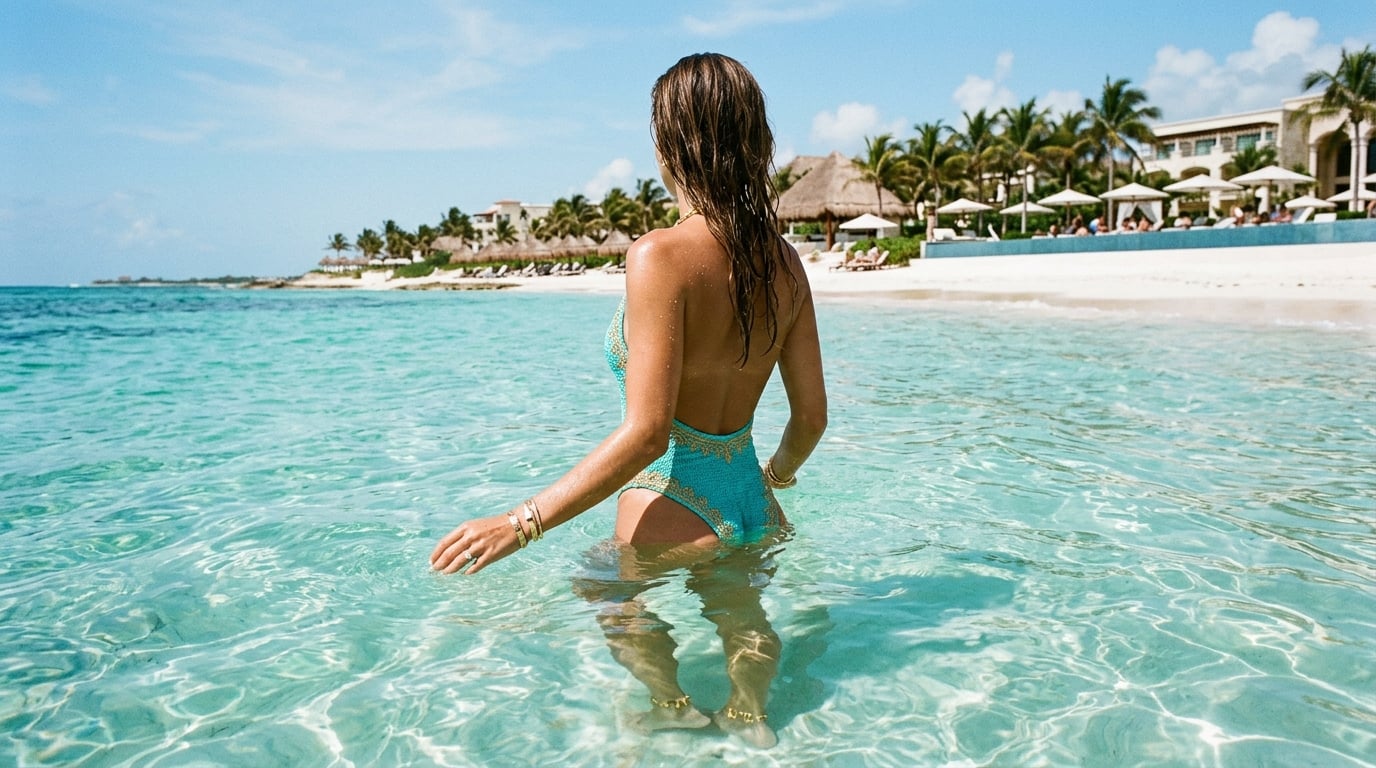
The Caribbean coast of Mexico in May is standing at a threshold. The dry season is technically over; the rainy season hasn't fully committed. What you get is the best of both in terms of the landscape — the Yucatán turquoise is at its clearest before the summer storm runoff — and the most demanding of conditions for skin. Heat is real. Humidity is serious. And the UV index, which can reach 11 in May (that's extreme, the highest classification), doesn't ask permission before doing what it does.
Cancún itself is a specific kind of place — a planned resort city, entirely engineered for international tourism, with a hotel zone (the Zona Hotelera) that runs along a narrow spit of land between the Caribbean and a lagoon. It is not charming in the way that Mexico City is charming or that Oaxaca is charming. It is, however, extraordinarily good at one thing: letting you be near that water. And from a beauty standpoint, the challenge is entirely about how to be near that water without paying for it with your skin.
UV Index 11 and What That Actually Means
UV index 11 is classified as extreme. At this level, unprotected skin can begin to burn in fewer than 10 minutes. In May, peak UV in Cancún occurs between approximately 10am and 3pm — a five-hour window during which outdoor activity without protection is inadvisable at almost any level.
This is not scaremongering; it's the specific information you need to make sensible choices. The turquoise water is beautiful. Being in it at 11am is physically lovely. But the UV reflection off the water's surface adds approximately 10–25% additional UV exposure on top of the direct sun. Combined with salt water that washes away even water-resistant sunscreen, the scenario is one that requires both excellent product choice and discipline in reapplication.
The sunscreen strategy:
- SPF 50 minimum. SPF 50+ if you're going to be in the water.
- Mineral sunscreen (zinc oxide or titanium dioxide) is preferable for extended outdoor or water exposure. It sits on top of skin and reflects UV rather than absorbing it, making it more stable in water, heat, and humidity.
- Reapply every 90 minutes if outdoors, or immediately after swimming or towelling off — regardless of the product's claimed water resistance.
- Apply before sun exposure, not after. At least 15 minutes before going outside.
- Body sunscreen matters as much as face sunscreen. The back of the neck, tops of feet, shoulders, and décolletage are the areas people reliably miss. These are also the areas that show premature ageing most clearly.
Skin in High Humidity
Cancún's May humidity sits around 75–80%. For some skin types this is wonderful — dryness simply stops being an issue. For others, particularly those prone to oiliness, congestion, or breakouts, tropical humidity creates specific problems.
The combination of heat, humidity, and sunscreen creates a situation where pores are working harder to breathe and products are sitting on skin differently than they would in a drier climate. Breakouts that don't occur at home may appear by day three in Cancún. This is a known pattern, and it's manageable.
For oily or combination skin in tropical humidity:
- Switch to a lightweight, gel-based moisturiser if you use a richer formula at home. You need hydration but not additional occlusion.
- Use a niacinamide serum. Niacinamide regulates sebum production, which will be in overdrive in the heat.
- Cleanse twice daily — this is genuinely necessary rather than optional in this climate. A gentle foaming cleanser morning and evening.
- Avoid heavy, comedogenic sunscreen formulas. A lightweight mineral SPF fluid or gel is worth seeking out specifically for this trip.
For dry or normal skin in tropical humidity:
- The humidity largely takes care of your hydration needs. Your routine can simplify: a light cleanser, a light SPF moisturiser, done. The skin will drink what the air provides.
- Focus your effort on sun protection and after-sun care rather than intensive moisturisation.
After-sun care: this is non-negotiable in Cancún. Aloe vera gel (ideally pure aloe, not a product that's 20% aloe in a base of thickeners and fragrance) applied in the evening will soothe cumulative UV stress even if you haven't visibly burned. A restorative serum — niacinamide, centella asiatica, or vitamin C — applied after the aloe supports repair while you sleep.
Hair and the Caribbean
Salt water, chlorine from the hotel pool, humidity, and UV — the Caribbean is not kind to hair without intervention. What you do in the first five minutes after swimming determines a great deal.
The protocol:
- Apply a leave-in conditioner or a UV-protective hair product before going to the beach or pool.
- After swimming in the ocean or pool, rinse with fresh water as soon as you can. Leaving salt or chlorine in your hair while in UV light significantly accelerates damage.
- Use a hair mask or deep conditioning treatment every two or three days, not as an indulgence but as maintenance.
- Protective styles — braids, twists, a plait — dramatically reduce the mechanical damage from wind, salt, and UV exposure on the hair shaft. This is not a question of preference; it's practicality.
Curly and wavy hair in Caribbean humidity: you already know what's going to happen, which means you can plan for it rather than fight it. A strong hold curl cream applied before going out, diffused or air-dried, and then left alone. Touching it will disturb the cast. Refrain.
Straight hair: anti-humidity serum is your best friend. Apply to dry hair before going out. Accept that by hour three at the pool, physics has won. A sleek low bun or ponytail is the elegant surrender.
Makeup in Cancún
The honest truth: heavy makeup in May Cancún is a commitment that the climate will challenge at every turn. Heat and humidity mean that anything not specifically formulated for these conditions will migrate, melt, or simply disappear.
What actually works:
- A waterproof tinted SPF or BB cream as your base. It does three jobs at once and is designed for skin that sweats.
- Waterproof mascara — this is one context where waterproof isn't optional.
- A cream blush applied lightly with fingers and then powdered lightly over the top — this holds better than pure cream or pure powder alone.
- A long-wear lip colour in a formula that doesn't transfer. Liquid lip products or lip stains are significantly more practical than traditional lipstick.
- A mattifying setting spray specifically designed for humidity (Urban Decay's All-Nighter, Make Up For Ever's Mist & Fix). Apply in thin layers.
When to dial back: daytime at the beach or pool. A light tinted SPF and waterproof mascara is the appropriate level of effort. Nobody is wearing contouring to a cenote. (That comes in the Tulum piece, but the principle applies across the Yucatán.)
The Resort Life Context
Cancún's Zona Hotelera exists entirely in service of a specific kind of ease. The hotels are large and competent; the beach is access-controlled by the hotel brands; the restaurants are designed for international appetites. This is not a criticism — it's a context. If you're staying in the hotel zone, take advantage of what that context provides: air conditioning that lets your makeup survive, hotel spas that understand tropical hair and skin needs, pools where the chlorine is well-managed.
The shift to downtown Cancún — El Centro — is worth making for at least one evening. The city that existed before the tourism industry is different in energy and more interesting. Dress for the heat rather than for the air conditioning, because there's less of it.
What to Pack
- SPF 50+ mineral, face (a lightweight fluid or gel formula)
- SPF 50 water-resistant, body
- After-sun aloe vera gel
- Niacinamide serum
- Lightweight gel moisturiser
- Leave-in conditioner and hair UV protector
- Hair mask (travel size)
- Waterproof mascara
- Long-wear lip stain
- Humidity-proof setting spray
- Protective hair accessories (silk scrunchies, pins — no rubber bands)
When the UV Has Been Doing Its Work
Even with impeccable sun protection, a week of Caribbean UV leaves its mark — usually subtle hyperpigmentation, a general dehydration that manifests as slight dullness once you're home, and potentially some sensitivity on sun-exposed areas. The transition from tropical heat to Lisbon's more moderate climate (particularly if you're returning in the cooler part of May) can be jarring for skin that has spent a week adapting to the Caribbean.
A professional treatment that specifically addresses post-sun skin — hydration, pigmentation prevention, barrier repair — is significantly more effective at this point than any self-administered routine. It's the kind of reset that makes a real difference.
Good Hands is an on-location hair and makeup service based in Lisbon. We come to you.