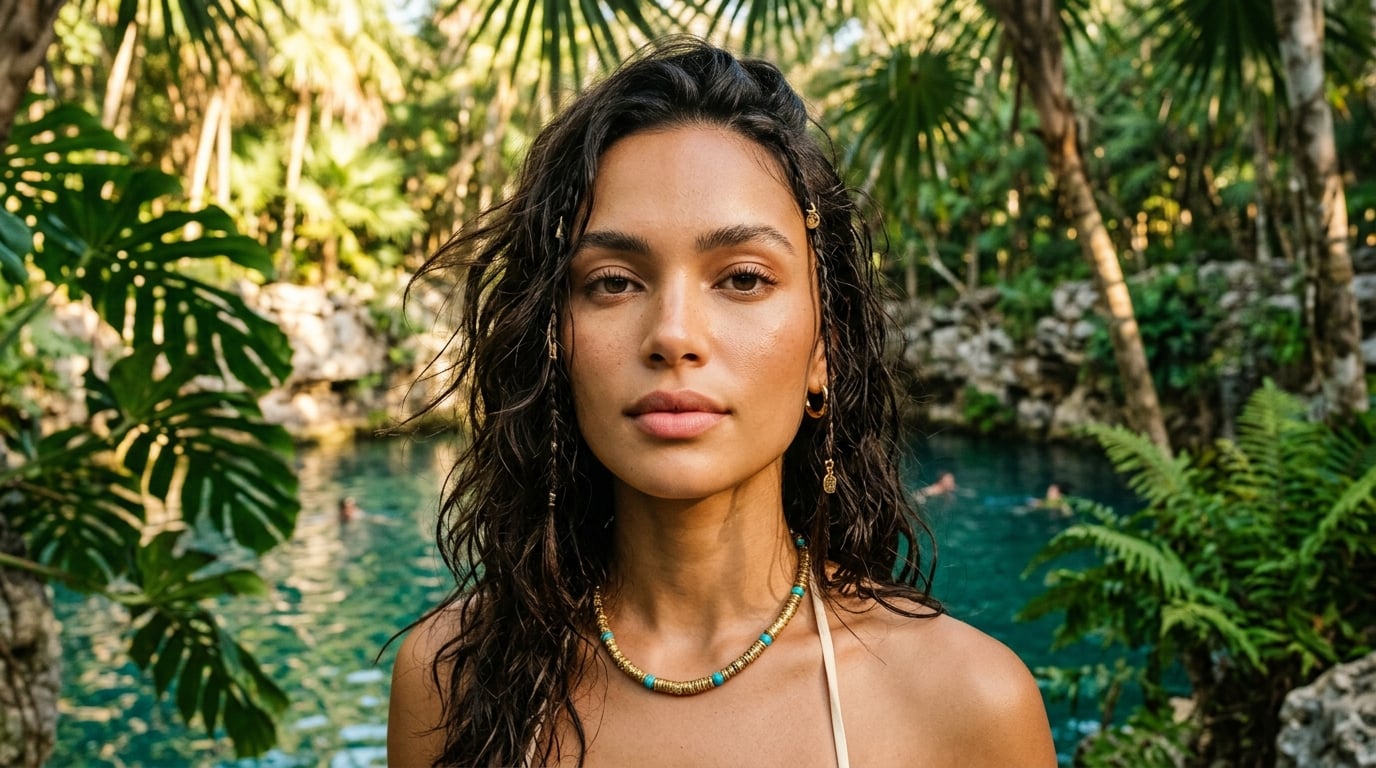
Tulum performs wellness back at you. It is very committed to this performance — the raw cacao ceremonies, the rooftop yoga, the cold brew with adaptogens, the hotels that describe themselves as "eco-chic" while charging Parisian prices for a platform bed under a palapa. None of this is a reason not to go. The jungle behind the beach road is genuinely extraordinary. The Mayan ruins on the clifftop above the Caribbean are extraordinary. The cenotes — those freshwater limestone caves filled with impossibly clear water — are extraordinary. The food, when you get off the tourist strip, is extraordinary.
What Tulum's wellness culture sometimes misses is the practical reality of what living in a jungle does to your skin. The ideology favours mineral sunscreen and coconut oil and crystal deodorant. The actual humidity, UV index, and fungal spore count of coastal Mexican jungle in May favour something rather more specific.
The Environment in May
Tulum sits at 20 degrees north latitude on the Caribbean coast of the Yucatán Peninsula. In May, it is at the tail end of the dry season — hot, increasingly humid, with afternoon rain becoming more frequent as the month progresses. Temperatures reach 32–34 degrees in the day and don't drop below 24 at night. Humidity runs between 75 and 90%. The UV index matches Cancún at 10–11: extreme.
The Tulum difference from Cancún is the jungle. The hotel zone runs along a beach road that transitions rapidly into dense tropical forest — cenotes hidden within it, archaeological sites beyond. The jungle adds its own layer to the beauty context: spores, insects, humidity trapped by the canopy. Within the jungle sections of Tulum, the air is close and warm and biologically active in a way that the Cancún Zona Hotelera, scrubbed and air-conditioned, is not.
Sun Protection in Tulum (The Reef Reef Reality)
Tulum's stretch of the Mesoamerican Barrier Reef — the second largest in the world — is close to the shore and genuinely accessible. It is also at significant risk from chemical UV filters. The Mexican government has restricted certain chemical sunscreen ingredients in protected areas, and enforcement in the cenotes (which are connected to a vast freshwater cave system that flows to the sea) is becoming more active.
This is not just a legal consideration — it's an ecological one, and it's worth taking seriously.
What to bring:
- Mineral sunscreen only. Zinc oxide and titanium dioxide are reef-safe in the concentrations used in commercial sunscreens. They are also, as noted in the Cancún guide, more stable in water and heat.
- Look for SPF 50 formulas specifically designed for reef environments — many outdoor and dive brands produce these. Some Tulum hotels sell them in their beach shops, often at inflated prices; bring from home.
- Apply 20–30 minutes before water exposure. Mineral sunscreen needs time to set.
- Reapply every 90 minutes regardless of water resistance labelling. The cenote water is cold (a consistent 23–25 degrees) and beautiful, but it actively rinses product off skin.
A note on tanning oil and accelerators: in ecological protected areas, these are not appropriate, and in Caribbean UV they are genuinely dangerous. The "base tan before Tulum" approach doesn't protect from UV index 11. Nothing short of SPF does.
Cenote Skin and Hair
The cenotes are the non-negotiable experience of the Yucatán, and they are worth everything people say about them. The water is extraordinary — fresh, cold, crystalline. It also has specific properties that affect both skin and hair.
The water composition: cenote water is slightly alkaline and calcium-rich — filtered through limestone, it picks up minerals as it moves through the cave systems. It's not harsh like salt or chlorine, and for skin it's generally gentle. For hair, the calcium is what matters: it can roughen the cuticle with repeated exposure, making strands feel dry and porous even though you've been swimming in fresh water. Many people find their skin feels clean and calm after cenote swimming; the hair is a different story.
For hair, it's more variable. The alkaline pH can lift the hair cuticle, leaving hair feeling slightly rough or lacking shine. If you swim in a cenote and then air-dry without any product, the result is often clean but somewhat flyaway hair with diminished shine. Apply a leave-in conditioner after rinsing and before drying. If you have colour-treated hair, the alkaline water will cause some colour lift over multiple cenote visits — a colour-protecting serum used as a leave-in is worth having.
The cave sections: some cenotes involve swimming into or under caverns, where the only light is filtered through openings in the limestone above. The experience is genuinely surreal. Practically: hair tied back securely, no products in the water that might contribute to the cave ecosystem (the same reef logic applies), and a waterproof mascara that won't stream if you're moved to tears by the light effects, which happens.
Skin in Jungle Humidity
The Tulum wellness narrative often involves minimal product use, "letting your skin breathe," and replacing conventional skincare with natural alternatives. Some of this is well-intentioned and some of it is simply branding. What the jungle humidity actually does to skin is worth separating from the ideology.
What happens: at 80–90% humidity, transepidermal water loss (the process by which skin loses moisture to the environment) essentially stops. Your skin won't dehydrate in the way it does in a dry climate. What it will do instead is retain heat, produce more sebum, and potentially experience congestion as pores become temporarily more active in the warm, thick air.
What this means for your routine:
- Lightweight, breathable products. Gel moisturisers, essence-level hydrators, nothing occlusive or cream-heavy.
- Niacinamide serum to regulate the sebum surge. Also worth noting: niacinamide has anti-inflammatory properties that can help with the minor skin irritation that jungle insects cause (some people find the minor bites or brushes with local plants cause more redness than they would at home).
- Gentle exfoliation twice weekly — the combination of humidity and SPF reapplication can cause congestion. A gentle chemical exfoliant (lactic acid or mandelic acid, milder options than glycolic) used in the evening will keep things clear without compromising your barrier under UV.
- A strong, reliable deodorant. The wellness deodorant made from crystals and intention will not function in Tulum in May. A clinical-strength antiperspirant, applied at night to clean dry skin, is what the heat actually requires.
Makeup in Tulum
Tulum's aesthetic is specific: bronzed skin, slightly tousled hair, minimal and intentional. Over-made-up reads as out of place — not because the culture is necessarily wiser, but because the heat makes it functionally difficult to maintain. By 10am the air temperature and humidity will have undone most conventional makeup.
What works:
- A tinted reef-safe mineral SPF as your entire base. Some formulas (Coola, Raw Elements, Kinfield) are sheer enough to work as a skin tint and are designed for exactly this environment.
- A natural brow gel or pomade — the humidity means pencil tends to smear.
- Waterproof mascara, used sparingly. Brown tones rather than black suit the Tulum aesthetic and the light, which is warmer and less sharp than morning city light.
- A tinted lip balm or lip oil. In high humidity, lip glosses and oils are actually pleasurable rather than sticky — the humidity stops the tackiness.
- Absolutely no contour or heavy foundation, not because of ideology but because it will be unrecognisable within an hour.
For evenings — the restaurants and beach bars of Tulum's main strip, particularly on the Hotel Zone road, become the social arena after sundown. The light is candlelit and forgiving. A bronzer used as a light wash over already-sun-kissed skin, a bold lip in a berry or nude-brick tone, and clean skin underneath. That's the move.
What to Pack
- Mineral SPF 50+ (face and body — reef-safe)
- Niacinamide serum
- Lightweight gel moisturiser
- Aloe vera gel for after-sun
- Leave-in conditioner (the cenote essential)
- Hair UV-protection leave-in or spray
- Waterproof mascara
- Tinted lip balm or lip oil
- Clinical-strength deodorant
- A wide-brim hat that actually stays on in jungle wind
- A silk or lightweight cotton scarf (versatile: hair, sun protection, wrap)
Leave at home:
- Your full foundation collection. You won't use it.
- Heavy fragrances. The jungle has its own scent, and competing with it feels like a mistake. A light skin scent or nothing is better.
- Anything labelled "mattifying" — the humidity will win and you'll just have dry-looking, matted skin rather than dewy.
The Mayan Ruins at Sunrise
El Castillo — the main temple at Tulum's archaeological site — looks over a cliff at the Caribbean. At sunrise, particularly in May when the sky turns from navy to pink to gold over the water, it is one of those sights that adjusts your sense of scale. People arrive early to have a moment with it before the tour groups.
This is a practical beauty note as much as anything: the sunrise walk to the ruins at 6am means going out before full UV, which means you can hold off on SPF reapplication until you arrive. But the morning light at the ruins is strong and direct off the sea. Apply before you go.
The Return
Coming back from Tulum to Lisbon is one of the more significant climate transitions you can make — from Caribbean jungle heat and humidity to the Atlantic temperate coast. Your skin, which has spent days adapting to extreme conditions, will feel the shift. Dryness that wasn't present in Tulum may emerge within the first 48 hours home. A hyperpigmentation check is worth doing — UV index 11 leaves its mark even through excellent sunscreen, and catching any new spots early allows for faster resolution.
The full reset — a professional treatment to restore hydration, calm any post-sun inflammation, and properly evaluate what the trip has done to your skin — is something that makes sense after a trip like this rather than as an aspiration. When you're back in Lisbon and ready for it, we're here.
Good Hands is an on-location hair and makeup service based in Lisbon. We come to you.