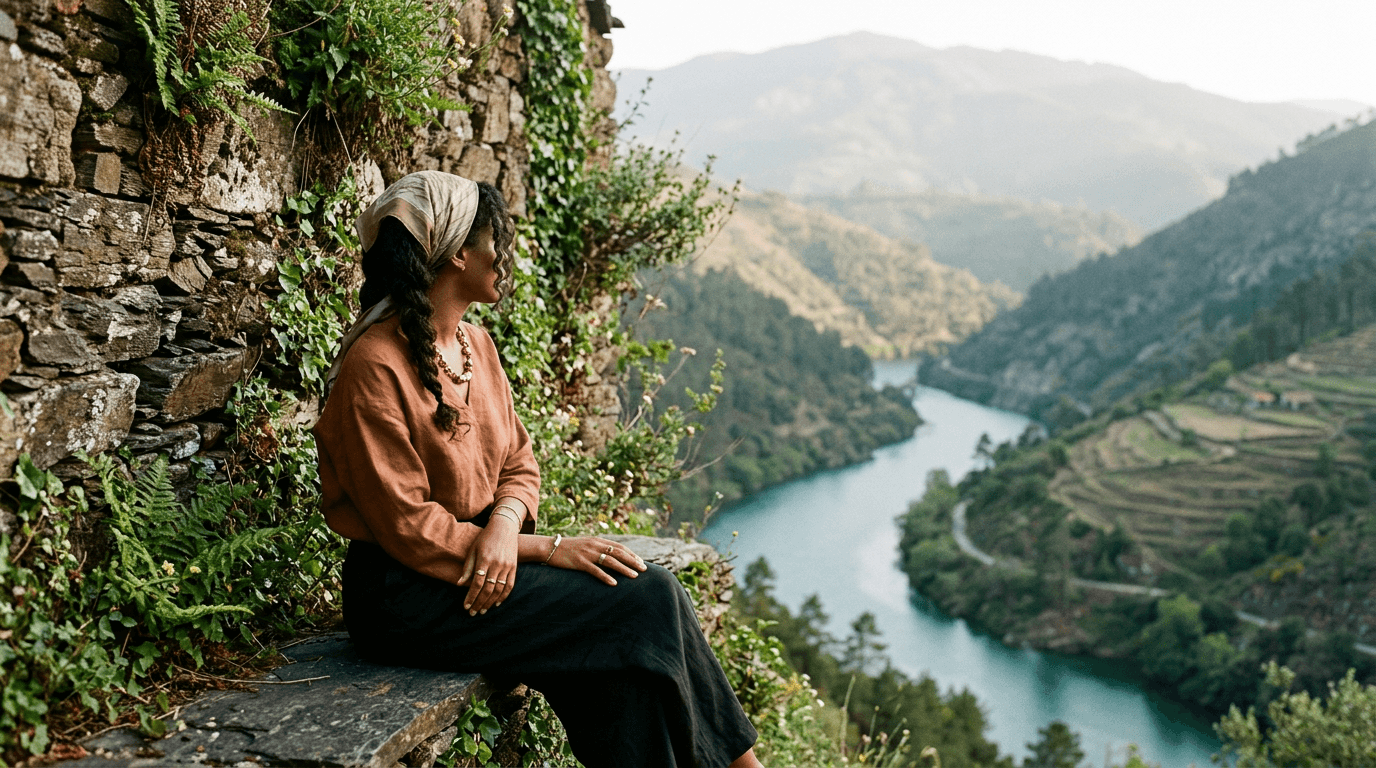
Sertã is the kind of place that doesn't have a tourism office, doesn't appear in the Condé Nast travel supplements, and doesn't need to. It sits in the Zêzere river valley in central Portugal, about two and a half hours from Lisbon, in a landscape of schist and eucalyptus and terraced hillsides that haven't particularly changed their essential character in several centuries. The town itself is small and practical — a market, a couple of good restaurants, a medieval tower. What surrounds it is the draw: the river, the levadas, the aldeia villages of stacked dark stone, and in March, wildflowers you didn't know had Portuguese names.
There are no queues here. No heritage site management. No one trying to photograph the same vista as forty other people. If you come to Sertã in March, you will almost certainly be the only person you've heard of who has done so. This is entirely the point.
What Your Skin Does When You Stop
Before getting into specifics: the most significant beauty effect of a place like Sertã is not the product interaction or the climate adjustment. It's the absence of the urban stress load. Cortisol has a measurable effect on skin — it disrupts the barrier, elevates inflammation, and worsens most existing conditions from acne to rosacea to eczema. Two or three days of genuine rest in clean air, without a schedule, without screens particularly, without noise pollution — this registers on the skin.
It sounds unscientific and it isn't. The research on stress and skin is extensive. The point here is that Sertã, which has almost nothing to sell you and makes almost no demands, is functionally a skin recovery environment regardless of what products you bring. Keep that in mind when thinking about what to prioritise.
March in Inland Portugal
The weather in Sertã in March is genuinely variable. This is not Algarve, where March can feel like a warm dress rehearsal for summer. The Beira Baixa interior runs on its own schedule: a warm morning can give way to genuine afternoon cloud, and the evenings in early March still carry the memory of winter. Temperatures typically range from 8 to 17 degrees during the day, dropping considerably at night.
The river — the Zêzere, which runs remarkable shades of green depending on the light — is too cold for swimming in March but forms the landscape anchor for walks and mornings with coffee. The air near the river is genuinely clean in the way that urban air isn't — low particulate matter, high oxygen, the smell of green things growing. Skin in this environment often looks noticeably better within 24 hours. Don't overthink it.
UV in March inland: around 4, similar to the coast. Lower than summer but meaningful, especially if you're walking and the sun is out. SPF 30 applied in the morning is sufficient and sensible.
Skin Priorities for Rural Portugal
The practical considerations are fewer than a city trip and different in character:
Dryness: unlike the coast, the interior of Portugal can have genuinely dry air, particularly if there's been wind. A richer moisturiser than your summer standard is appropriate for March inland travel. Apply to slightly damp skin after washing your face — the Zêzere river towns sometimes have very soft local water, which is wonderful for hair but can slightly disrupt skin if you're not used to it.
Barrier care: you're outdoors more in Sertã than you would be in a city. Walks through schist villages, time by the river, afternoons on terraces overlooking valley views — sun and wind exposure is sustained rather than occasional. A physical SPF that also moisturises (many mineral formulas do both) simplifies the morning routine without sacrificing protection.
Minimalism works here: Sertã is not a context that calls for a ten-step routine. This is the environment where a cleanser, a good moisturiser with SPF, and a lip balm will carry you through the day comfortably. The rest you can leave at home. Your skin doesn't need compensating here — it needs breathing room.
Hair in the Zêzere Valley
March in rural Portugal means variable wind — sometimes warm and from the south, sometimes sharp from the north. In the valley specifically, the topography channels airflow, which means good hair days and bad hair days can alternate within the same afternoon.
The practical approach: low-maintenance styles that don't require revisiting. A loose plait stays neat in wind without needing adjustment. A bun stays where it's put. If you have the kind of hair that looks better the second day than the first — many curly or wavy textures do — lean into that. Wash the first evening, apply a leave-in, braid or pin, and emerge the next morning with hair that looks like it was professionally styled in a much simpler time.
The water: the Zêzere basin water quality is generally very good — some of the cleanest river water in Portugal runs through here. If you're staying somewhere with a good shower, you'll notice the difference in your hair after washing. Soft water rinses product out more thoroughly and leaves less residue. You may need slightly less conditioner than usual.
The Aldeia Walks
Sertã's surroundings include several of Portugal's schist villages — aldeias de xisto — small communities of stacked dark stone that cling to hillsides with a kind of geological inevitability. Walking to them in March means muddy paths after rain, moss-covered stone steps, and the specific exhilaration of a landscape that's indifferent to being picturesque and is, therefore, genuinely beautiful.
For these walks: practical beauty over aspirational beauty. A tinted SPF moisturiser, a water-resistant mascara, comfortable clothes. The schist villages are not Instagram content — they're places where people live and have lived. Showing up over-made-up feels like a category error. Let the place set the tone.
A word on lips: the March wind in the valleys is specifically drying on lips. A tinted lip balm applied before setting out means colour and protection without a separate step. Reapply after lunch.
What to Pack (and What Not To)
Pack:
- A rich but not heavy moisturiser
- SPF 30 mineral (face)
- Lip balm with SPF (tinted is nice)
- A gentle cleanser (travel size)
- Leave-in conditioner for hair
- One or two functional rather than aspirational makeup pieces
Don't pack:
- Your full skincare collection. It won't get used.
- Heavy foundation. The light here is kind — softer and more diffuse than city light — and you won't want it.
- Fragrances that compete with the landscape. The smell of schist in rain, wild herbs on sunny paths, wood smoke from village houses in the evening — these are worth registering without interference.
The Return
The drive back from Sertã to Lisbon takes you through the Serra de Candeeiros and the Tagus valley, dropping from interior highland into coastal basin. By the time you reach the city, the air has changed — more particles, more noise, the particular quality of urban life resuming. Your skin, which has had a few days of clean air and slow pace, will feel the transition before you consciously register it.
This is a good moment for a genuine cleanse, a proper mask, and the kind of intentional self-care that the week in Sertã made possible by not being required. When you return and think about what treatment would actually restore the feeling of those days — we think about that too.
Good Hands is an on-location hair and makeup service based in Lisbon. We come to you.